
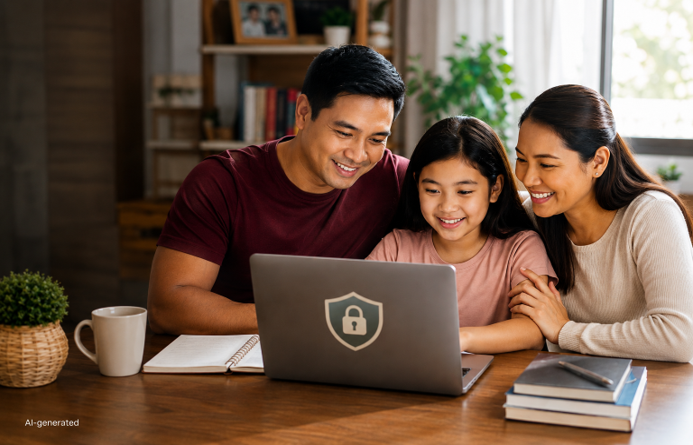
Every morning, parents send their children off to school with reminders to behave, and a familiar instruction: Mag-ingat ka.
Today, that reminder must extend to the digital world. Whenever children go online to study, play, watch videos, or chat with friends, they may encounter suspicious links, fake giveaways, hacked accounts, online strangers, cyberbullying, misinformation, and manipulated content.
The internet offers many opportunities to learn, create, and connect. But it can also expose children to suspicious links, fake giveaways, hacked accounts, online strangers, cyberbullying, misinformation, and manipulated content.
Just as in the physical world, parents need to ensure that children enter and engage with digital spaces that are age-appropriate and child-friendly. Before letting children go online and access apps, parents must check and enable available parental controls, privacy settings, content restrictions, and other safety features to reduce risks to children.
Teach children to spot the warning signs
Online risks do not always look dangerous at first glance.
They may appear as a message from a classmate asking for a password, an offer of free game credits, a viral video presented as fact, or a friendly stranger inviting a child to continue chatting privately.
Some messages create pressure by claiming an account will be suspended, a prize will expire, or someone needs urgent help. Others may come from fake or hacked accounts that look familiar enough to earn a child’s trust.
This is why children need more than a list of rules. They need a simple habit to use whenever something online feels unusual: Pause, Check, and Tell.
Pause before clicking or replying
Children are naturally curious, especially when a message promises free game currency, prizes, exclusive content, or access to something popular.
Teach them to pause before clicking a link, opening a file, downloading an app, replying to an unfamiliar account, or sharing information.
They should also avoid acting on messages that try to frighten, pressure, or excite them. Scammers often rely on urgency to keep people from thinking carefully.
A helpful family rule is simple: when a message says “act now,” pause and think first.
Check the person, message, and source
Children should learn that not everything online is as it seems.
A message may display the name or photo of someone they know but still come from a fake or compromised account. A video may look convincing but may have been edited or generated using artificial intelligence. A viral post may also present opinion, fiction, or incomplete information as fact.
Encourage children to ask, “Who sent this? Do I know this person in real life? Why are they asking for private information? Does the link or account look unusual? Is the information reported by a credible source? Could the photo, audio clip, or video have been altered?”
Checking does not require advanced technical knowledge. It begins with slowing down and questioning what they see.
Tell a trusted adult when something feels wrong
Children should know they can approach a parent, teacher, or trusted adult when something online makes them feel confused, pressured, threatened, embarrassed, or uncomfortable.
They should also be encouraged to speak up even if they have already clicked a suspicious link, replied to a stranger, or shared something they regret.
Fear of punishment can lead children to hide mistakes, which may give scammers, bullies, or online strangers more opportunity to continue contacting or manipulating them.
Parents can build trust by responding calmly, focusing first on the child’s safety, and solving the problem together. A child who knows they will be heard is more likely to ask for help early.
Cases or suspected cases of child abuse, exploitation, or other threats to a child’s safety may be reported to the MAKABATA Helpline 1383, the government’s national hotline for concerns involving children.
Finding support in an online village
Raising children in the digital age can feel overwhelming, especially as online threats continue to evolve.
Parents may encounter new scams, unfamiliar apps, AI-generated content, and online behaviors they did not experience growing up. They do not have to navigate these challenges alone.
Since 2022, PLDT Home’s Online Alerto has provided Filipino families with a space to exchange experiences, learn about emerging digital threats, and discover practical ways to build safer online habits at home.
The community helps parents learn from real-life situations, share warnings about scams and suspicious online activity, and become more confident in guiding their children.
Parents cannot keep children entirely away from the digital world. The internet is already part of how they learn, communicate, relax, and prepare for the future.
What parents can do is give them the habits they need to recognize danger and respond wisely.
Before they click, reply, share, or trust, remind them to Pause, Check, and Tell.
It can help children explore the online world with greater confidence, caution, and care.
Be part of the conversation and learn more about protecting your family online. Join the Online Alerto Facebook community at facebook.com/groups/onlinealerto.ph.